Career · Chapter 06
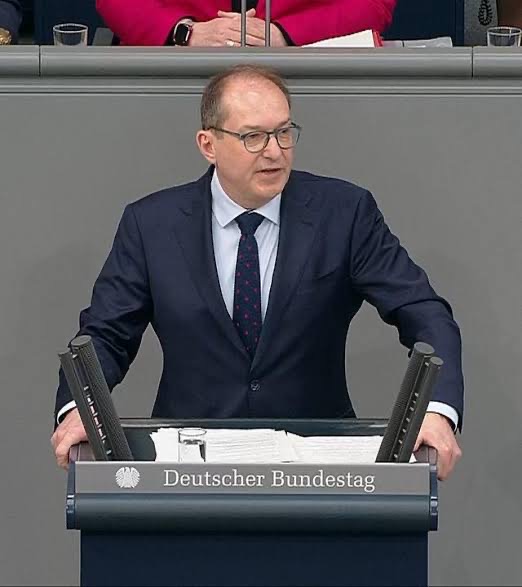
Member of the Bundestag
Alexander Dobrindt has represented the Weilheim constituency in Upper Bavaria since 2002 — seven legislative periods, three of them in opposition, four in government, and every one of them won directly.
First-vote results in Weilheim
Share of first votes (Erststimmen) won by Alexander Dobrindt. Sources: Federal Returning Officer; German Wikipedia. The 2002 result is omitted because published sources give conflicting figures.
Seven Bundestag terms
Select a legislative period to see the government of the day and Dobrindt’s role.
A newcomer in opposition
Dobrindt entered the Bundestag after the election of 22 September 2002, in which the Union under its candidate for chancellor Edmund Stoiber narrowly failed to win power. As a new Member he concentrated on economic policy. From January to November 2005 he served as deputy chairman of the Committee on Economics and Labour. The legislative period ended early after Chancellor Schröder lost a vote of confidence in July 2005.
Economic-policy spokesman
With the Union back in government in a grand coalition, Dobrindt became economic-policy spokesman of the CSU Landesgruppe, chairing its working group on the economy, technology, energy, education and research from December 2005 to November 2008. He was a board member of the parliamentary group’s Mittelstand caucus. From November 2008 to February 2009 he chaired the CDU/CSU working group on education and research, before being appointed CSU Secretary General in February 2009.
Parliamentarian and party strategist
Throughout this term Dobrindt combined his seat with the office of CSU Secretary General in Munich. His public profile was shaped less by parliamentary work than by his role as the party’s chief campaigner, culminating in the 2013 state and federal elections. CSU Secretary General
Minister on the government bench
From 17 December 2013 Dobrindt sat on the government bench as Federal Minister of Transport and Digital Infrastructure. He piloted the car toll through the Bundestag (passed on 27 March 2015 with 434 votes to 128) and its amendment in March 2017, as well as the HGV toll extension and the automated driving law. On 16 February 2017 he gave evidence to the Bundestag’s committee of inquiry into the emissions scandal. Transport & infrastructure
Chairman of the CSU Landesgruppe
Elected chairman of the CSU Members on 26 September 2017, Dobrindt became first deputy chairman of the CDU/CSU parliamentary group, serving under group chairmen Volker Kauder and, from September 2018, Ralph Brinkhaus. He was part of the CSU’s negotiating teams in the failed “Jamaica” exploratory talks of 2017 and the grand coalition negotiations of early 2018. Leadership
Leading voice of the opposition
In opposition Dobrindt remained Landesgruppe chairman, from February 2022 alongside group chairman Friedrich Merz. He was among the sharpest critics of the traffic-light coalition. After its collapse in November 2024 he called for an immediate vote of confidence. In the last weeks of the term he was one of the leaders of the Union group when its migration motion passed on 29 January 2025 with votes from the AfD and FDP, and when the “Influx Limitation Act” failed on 31 January 2025 (338 votes in favour, 349 against). Controversies
Back on the government bench
Since 6 May 2025 Dobrindt has addressed the Bundestag as Federal Minister of the Interior, introducing legislation on family reunification (passed 27 June 2025), citizenship (8 October 2025), safe countries of origin (5 December 2025), the reform of the Common European Asylum System (27 February 2026), aviation security and drone defence (26 February 2026) and the Federal Police (25 September 2026). His successor as Landesgruppe chairman is Alexander Hoffmann. Parliamentary record
Important votes he shaped
| Date | Vote | Result | His role |
|---|---|---|---|
| 27 Mar 2015 | Infrastructure Levy Act (car toll) | Passed: 434 yes, 128 no, 6 abstentions | Responsible minister |
| 29 Jan 2025 | Union motion on migration (five points) | Passed: 348 yes, 344 no, 10 abstentions | Landesgruppe chairman; speaker in the debate |
| 31 Jan 2025 | Influx Limitation Act | Rejected: 338 yes, 349 no, 5 abstentions | Landesgruppe chairman |
| 27 Jun 2025 | Suspension of family reunification (subsidiary protection) | Passed: 444 yes, 135 no | Responsible minister |
| 8 Oct 2025 | End of three-year fast-track naturalisation | Passed: 450 yes, 134 no, 2 abstentions | Responsible minister |
| 5 Dec 2025 | Safe countries of origin by ordinance | Passed: 455 yes, 130 no, 3 abstentions | Responsible minister |
| 27 Feb 2026 | GEAS Adaptation Act (EU asylum reform) | Passed: 309 yes, 260 no, 2 abstentions | Responsible minister |
| 25 Sep 2026 | Federal Police Act reform | Passed: 322 yes, 134 no, 118 abstentions | Responsible minister |
Sources: German Bundestag text archive and roll-call records; contemporary reporting.