Government · Chapter 09
Two ministries, two eras
A decade separates Alexander Dobrindt’s two cabinet posts. In 2013 he took charge of Germany’s networks under Angela Merkel; in 2025 he took charge of its internal security under Friedrich Merz.
Transport & Digital Infrastructure
- In office
- 17 Dec 2013 – 24 Oct 2017
- Chancellor
- Angela Merkel (CDU)
- Coalition
- CDU/CSU–SPD
- Predecessor
- Peter Ramsauer (CSU)
- Successor
- Christian Schmidt (acting), then Andreas Scheuer
- Signature issue
- The car toll
The Interior
- In office
- Since 6 May 2025
- Chancellor
- Friedrich Merz (CDU)
- Coalition
- CDU/CSU–SPD
- Predecessor
- Nancy Faeser (SPD)
- Official title
- Bundesminister des Innern
- Signature issue
- Border controls and asylum
Minister for networks
Appointment and remit
Fact
After the 2013 election the CSU claimed the transport ministry to implement its car toll. Dobrindt, who as Secretary General had made the toll a campaign promise, was sworn in on 17 December 2013. The ministry was renamed and given responsibility for telecommunications and broadband — a portfolio of roads, rail, waterways, aviation and digital networks with one of the largest investment budgets in the federal government.
Priorities and initiatives
His main projects were the car toll (passed 2015, amended 2017), the Federal Transport Infrastructure Plan 2030 (€269.6 billion, adopted August 2016), an investment ramp-up to around €14 billion a year, the extension of the HGV toll to all federal roads, the Netzallianz and the federal broadband funding programme, and the 2017 law on automated driving.
Challenges
The European Commission opened infringement proceedings against the toll in June 2015. In September 2015 the Volkswagen emissions scandal broke, placing the ministry and its Federal Motor Transport Authority at the centre of a crisis involving Germany’s largest industry. In January 2017 the chief executive of Deutsche Bahn resigned abruptly.
Outcomes
Fact
Investment levels rose and the maintenance-first principle was written into the infrastructure plan. The HGV toll extension took effect in 2018. The broadband target of 50 Mbit/s for all by 2018 was missed (around 88 per cent coverage). The car toll never came into force: the Court of Justice of the European Union ruled it incompatible with EU law in June 2019.
Criticism and public response
Criticism
Critics accused him of prioritising a symbolic CSU project over sound law, of leniency towards carmakers in the diesel scandal, and of favouring road projects in his own region. Supporters credited him with putting infrastructure investment back on the agenda.
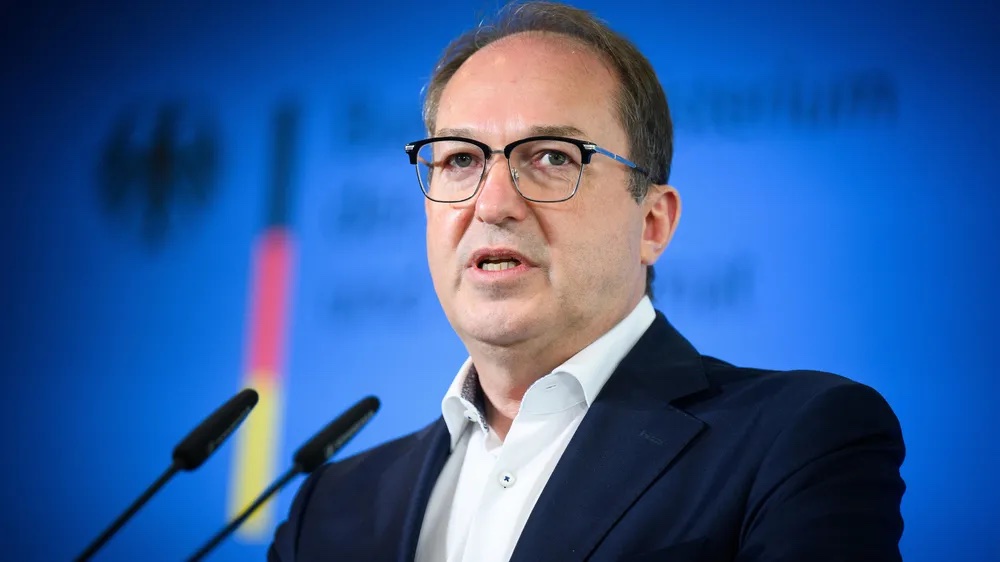
Minister of the Interior
Appointment and remit
Fact
Friedrich Merz was elected chancellor on 6 May 2025 in a second ballot with 325 votes, after failing to secure a majority in the first. Dobrindt was appointed and sworn in the same day. The interior ministry is responsible for, among other things, the Federal Police, the Federal Criminal Police Office (BKA), the Federal Office for the Protection of the Constitution (BfV), the Federal Office for Information Security (BSI), the Federal Office for Migration and Refugees (BAMF), civil protection and the Federal Agency for Technical Relief (THW).
„Wir wollen die Stabilität und den Zusammenhalt unserer Gesellschaft stärken, mit Klarheit, Konsequenz und Kontrolle!“ “We want to strengthen the stability and cohesion of our society — with clarity, consistency and control!” Alexander Dobrindt on taking office, 6 May 2025 (Federal Ministry of the Interior)
Priorities and initiatives
Migration has dominated his first year and a half: tightened border controls with rejections of asylum seekers from 7 May 2025, the suspension of family reunification, the end of three-year naturalisation, safe countries of origin by ordinance, the implementation of the EU asylum reform, and resumed deportations of offenders to Afghanistan and Syria. In security policy he has prioritised drone defence, cyber security, civil protection and a new Federal Police Act.
Challenges and legal limits
Fact
On 2 June 2025 the Berlin administrative court ruled that the rejection of three Somali asylum seekers at the German–Polish border had been unlawful; on 27 April 2026 the Koblenz administrative court found a control at the Luxembourg border unlawful. In both cases Dobrindt described the rulings as individual-case decisions and maintained his course. In February 2026 a Cologne court provisionally barred the BfV from labelling the AfD as confirmed right-wing extremist. In August 2026 an explosive drone was found at Leipzig/Halle airport; the government later attributed it to Russia.
Criticism and public response
Criticism
Neighbouring countries, including Poland, Switzerland and Luxembourg, criticised the border policy; Poland introduced its own controls from 7 July 2025. Civil-liberties groups awarded him a BigBrotherAward in October 2025 over surveillance plans including the possible use of Palantir software. Supporters point to falling asylum applications and to the coalition’s parliamentary majorities for his legislation.
What connects the two ministries
Signature projects
Both tenures were defined by a CSU flagship promise carried into government — the toll in 2013, border rejections in 2025 — and by the question of whether it could withstand European law.
Political risk
In both roles Dobrindt accepted legal risk in return for political visibility. The toll ultimately failed in court; the outcome for border rejections remains open as of October 2026.
Infrastructure of the state
Beneath the headline issues, both tenures involved long-term structural decisions — investment plans and networks in the first, police, cyber and civil-protection capabilities in the second.