Positions · Chapter 14
Political positions
Where Alexander Dobrindt stands, topic by topic — based on his documented statements, the legislation he has introduced and the positions of the groups he has led.
Thirteen topics. Each section separates documented positions from analysis.
Position
Migration has been Dobrindt’s defining issue since 2015. He argues that Germany’s capacity to integrate is limited and that irregular migration must be reduced through border controls, rejections at the border, restrictions on family reunification for people with subsidiary protection, faster procedures, safe countries of origin and the consistent deportation of offenders — including to Afghanistan and Syria. In January 2025, after the Aschaffenburg attack, he called for a “Vollbremsung” — a full braking — of migration, according to press reports. As interior minister he has implemented much of this agenda. Details of each measure.
Analysis
His position has been consistent for a decade; what has changed is his power to implement it. The principal constraint has been European and German administrative law, as several court rulings have shown.
Position
He favours extended powers for security authorities, arguing that the law must keep pace with technology: the Federal Police Act he introduced (passed 25 September 2026) adds metadata access, high-resolution station video and drone defence, replacing a law largely dating from 1994. He has supported biometric internet searches and a “technology-neutral” assessment of data-analysis software, including Palantir.
Criticism
Civil-liberties organisations gave him a BigBrotherAward in October 2025; the SPD has rejected Palantir at federal level.
Statement
In May 2025 he said he was personally convinced that the AfD, at least in its leadership, was right-wing extremist, but that it could not simply be banned; it had to be “governed away”. On presenting the 2024 domestic intelligence report in June 2025 he said the findings were not sufficient for a ban application. He banned the Reichsbürger association “Königreich Deutschland” on 13 May 2025.
Criticism
His January 2025 decision, as Landesgruppe chairman, to bring migration proposals to a vote that could only pass with AfD support was criticised by the SPD, the Greens, churches and large public demonstrations as weakening the firewall against the far right.
Position
Dobrindt supports the reformed Common European Asylum System, return centres in third countries and a stronger Frontex, and he has used European formats — the Zugspitze summit of July 2025 and the Munich Migration Meetings — to build alliances. At the same time he defends national internal border controls for as long as he considers them necessary.
Earlier statements
As CSU Secretary General during the euro crisis he took eurosceptic positions, suggesting in 2012 that Greece should consider a new start outside the eurozone. The pro-European association Europa-Union awarded him a negative prize, the “Europa-Distel”, in October 2012.
Analysis
As a CSU politician Dobrindt represents a party built on Bavarian autonomy. In practice, however, his ministerial work has centralised several matters: safe countries of origin can now be designated by federal ordinance without the Bundesrat, and the Federal Police gains new powers. Coordination with the states takes place in the Interior Ministers’ Conference; deportations remain largely a state responsibility.
Statement
„Die Sicherheit Israels gehört zu unserer Staatsräson.“ — “Israel’s security is part of our reason of state” (4 June 2025). He visited Israel in June 2025 and signed a cyber and security pact with Prime Minister Netanyahu on 11 January 2026. He has engaged closely with neighbouring countries over border controls, notably Poland, Switzerland, Austria and Luxembourg. International engagement.
Legislative action
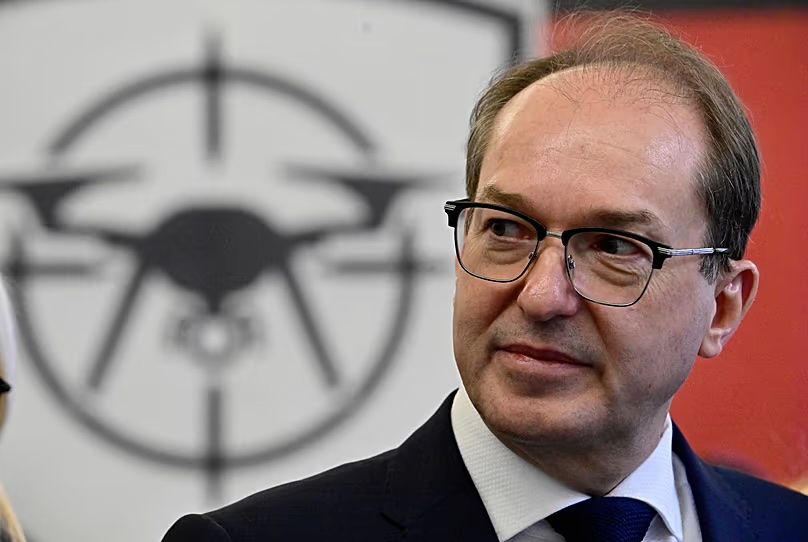
He set up a Federal Police drone-defence unit and introduced the amendment to the Aviation Security Act allowing Bundeswehr support against drones (passed 26 February 2026). After an explosive drone was found at Leipzig/Halle airport in August 2026, the government attributed it to Russia; Dobrindt said its components were familiar from other Russian hybrid operations. His €10 billion civil protection pact (announced September 2025) addresses resilience against crises and attacks.
Statement
In June 2024 he called for Ukrainian refugees in Germany to either take up work or return to safe areas of western Ukraine — a proposal rejected by the Foreign Office. In 2026 he expressed doubts about extending EU temporary protection to Ukrainian men of conscription age. His ministry has cited cooperation with Ukraine on drone defence.
Position
His transport policy rested on the principle that users should contribute to infrastructure financing (the car toll for foreign drivers, the HGV toll on all federal roads) and on maintenance before new construction. Transport & infrastructure.
Position
From broadband for rural areas and the first law on automated driving (2013–2017) to the NIS2 law and a German Cyber Dome (since 2025), Dobrindt has treated digital infrastructure as a question of competitiveness and, increasingly, of security. Digital infrastructure.
Position
In opposition he opposed the 2023 Buildings Energy Act. In November 2022 he warned against the emergence of a “climate RAF” in connection with the activist group Letzte Generation — a comparison the then president of the Federal Office for the Protection of the Constitution, Thomas Haldenwang, called “nonsense” from a professional perspective. Energy positions.
Statement
„Auf die linke Revolution der Eliten folgt eine konservative Revolution der Bürger.“ — “The left-wing revolution of the elites is being followed by a conservative revolution of the citizens.” (Die Welt, 4 January 2018). In 2013 he called advocates of same-sex marriage a “shrill minority” and said the Union should speak for the “silent majority”.
Criticism
Historians and opponents pointed out that “Conservative Revolution” is also the name of an anti-democratic intellectual movement of the Weimar era.
Analysis
A recurring theme of his interior ministry is the modernisation of state capabilities: a new police law, sirens and cell broadcast, equipment for civil protection, cyber defence structures. He has framed these under the slogan of “clarity, consistency and control”.