From G7 transport ministers in 2015 to the Zugspitze summit and Jerusalem a decade later: Dobrindt’s international work has always been tied to his domestic portfolio — first transport, now migration and security.
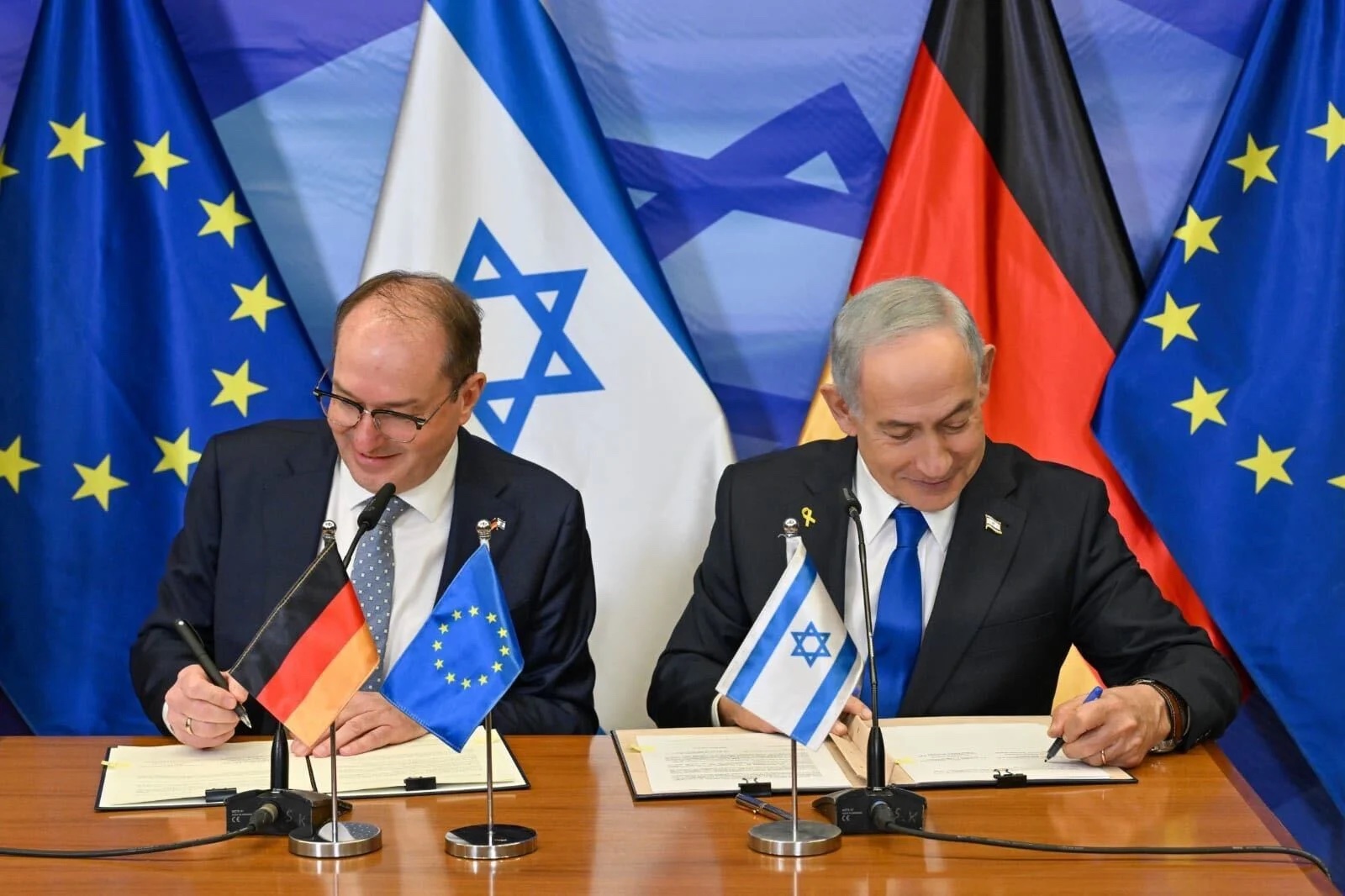
Signing the German–Israeli cyber and security pact with Prime Minister Benjamin Netanyahu, Jerusalem, 11 January 2026.
Featured
Israel
4 Jun 2025
Meets Foreign Minister Gideon Sa’ar in Berlin: „Die Sicherheit Israels gehört zu unserer Staatsräson.“
28–29 Jun 2025
Two-day visit to Israel shortly after the start of the Israel–Iran war; meetings with Netanyahu, Sa’ar and Defence Minister Katz, a visit to Bat Yam and talks with families of hostages. He announces a planned cyber and security pact.
11 Jan 2026
Signs the pact with Netanyahu in Jerusalem: cyber defence (“Cyber Dome”), a joint AI and cyber innovation centre, drone detection, civil protection and counter-terrorism. A political declaration of intent, not a treaty.
2026
First joint German–Israeli cyber-defence exercise, “Blue Horizon”.
01European formats
Building alliances on migration
Since 2025 Dobrindt has used summits hosted in Bavaria to shape the European debate.
18 Jul 2025
Zugspitze summit
Interior ministers of France (Bruno Retailleau), Poland (Tomasz Siemoniak), Austria (Gerhard Karner), Denmark (Kaare Dybvad Bek) and Czechia (Vít Rakušan), with EU Commissioner Magnus Brunner. A joint declaration set five goals: a tougher Common European Asylum System, fighting smugglers, consistent returns including via centres in third countries, external border protection and third-country partnerships.
4 Oct 2025
First Munich Migration Meeting
Ministers from Belgium, Denmark, Poland, Sweden, the Netherlands and Switzerland, with Commissioner Brunner.
27–28 Apr 2026
German-speaking interior ministers, Bourglinster
Germany, Austria, Switzerland, Liechtenstein and Luxembourg, with Commissioner Brunner: implementation of the asylum reform, visa policy, returns, organised crime, drones and civil protection.
26 Sep 2026
Second Munich Migration Meeting
Ministers from 17 European countries and Commissioner Brunner; Dobrindt proposes making Frontex a return agency with a rapid-reaction force deployable within 24 hours.
02Partners
Country by country
LULuxembourg
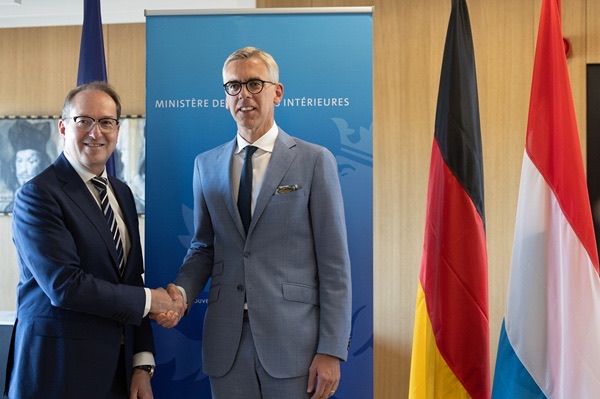
With Léon Gloden during his working visit to Luxembourg, May 2025.
On 30 May 2025 he visited Interior Minister Léon Gloden and promised to minimise the impact of border controls on the Greater Region’s commuters. Gloden remained critical of the controls. In April 2026 the two met again at Bourglinster, the day after a German court found a control at the Luxembourg border unlawful.
ATAustria
As transport minister, Dobrindt was in open conflict with Austria over the car toll; Austria sued Germany at the EU Court of Justice in October 2017 and won in 2019. As interior minister he has found an ally in Gerhard Karner, who joined the Zugspitze summit and the German-speaking ministers’ meetings.
PLPoland
Germany’s rejections at the border caused irritation in Warsaw; Prime Minister Donald Tusk introduced Polish controls on the borders with Germany and Lithuania from 7 July 2025. Dobrindt said there were no disagreements with Poland and held talks with Interior Minister Tomasz Siemoniak, who attended the Zugspitze summit.
CHSwitzerland
On 17 May 2025 Federal Councillor Beat Jans said Switzerland would not accept the rejections and indicated possible countermeasures. Switzerland later took part in the German-speaking ministers’ meetings and the Munich Migration Meeting.
NLNetherlands
The Netherlands supported Austria’s lawsuit against the German car toll. In January 2026 Germany and the Netherlands launched a working group on “innovative” third-country models for asylum and returns with Austria, Denmark and Greece, according to press reports.
SYSyria
After the end of the Assad era, Germany resumed deportations of offenders to Syria in December 2025. On 27 March 2026 Dobrindt signed a civil protection agreement with Syria’s Minister for Emergencies, Raed al-Saleh, under which the THW supports Syria’s emergency services. No readmission agreement has been reported.
AFAfghanistan & Qatar
A deportation flight to Kabul in July 2025 was organised with Qatar’s assistance; later technical talks with the Taliban authorities led to a first direct charter flight in February 2026.
G7G7 transport ministers
Under Germany’s 2015 G7 presidency, Dobrindt hosted the transport ministers in Frankfurt on 16–17 September 2015, who adopted a declaration on automated and connected driving.
EUEuropean Commission
As transport minister he negotiated the car toll compromise with Commissioner Violeta Bulc and President Jean-Claude Juncker (December 2016). As interior minister he works closely with Commissioner for Internal Affairs and Migration Magnus Brunner, who has nonetheless called for an end to internal border controls.