Career · Chapter 05
The CSU career
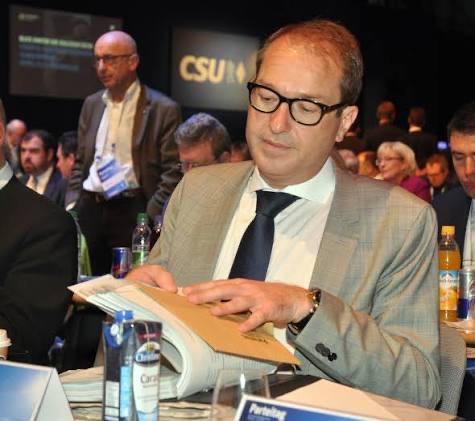
Dobrindt has belonged to the Christian Social Union since 1990. Two offices made him one of its most powerful figures: Secretary General from 2009 to 2013, and chairman of the party’s Members of the Bundestag from 2017 to 2025.
How the CSU works
The CSU is a party unlike any other in Germany: it stands for election only in Bavaria, yet it is a full partner in federal politics.
Fact
Founded in 1945, the CSU contests elections only in Bavaria, while its sister party, the CDU, contests elections in the other fifteen states. In the Bundestag, the two parties form a joint parliamentary group (Fraktionsgemeinschaft). Within it, the CSU Members form their own Landesgruppe, which has considerable autonomy, its own chairman and a guaranteed role in coalition negotiations.
The party chairman is supported by a Secretary General who runs the party headquarters in Munich, manages campaigns and acts as the party’s chief spokesman. In practice the Secretary General is expected to be combative: the role has produced several of the CSU’s most prominent figures, including Edmund Stoiber, Markus Söder and Andreas Scheuer.
Four phases in the party
- 1986 – 2009
Grassroots and district
Junge Union (from 1986), CSU (from 1990), local chairman in Peißenberg and, from 2009, district chairman of Weilheim-Schongau. Political beginnings
- 2009 – 2013
Secretary General
Appointed by Horst Seehofer on 9 February 2009; led the campaigns of 2009 and 2013 and handed over to Andreas Scheuer in December 2013.
- 2013 – 2017
The CSU’s man in the cabinet
As Federal Transport Minister he was responsible for implementing the CSU’s key campaign promise, the car toll. The car toll
- 2017 – 2025
Landesgruppe chairman
Elected on 26 September 2017 with 41 votes; led the CSU Members through the fourth Merkel government and the opposition years until 5 May 2025. Leadership
Secretary General: the party’s sharpest voice
Fact
Dobrindt took over the party headquarters in February 2009 at a difficult moment. In the Bavarian state election of September 2008 the CSU had fallen to 43.4 per cent and lost the absolute majority it had held since 1962, forcing it into a coalition with the FDP. Horst Seehofer, the new party chairman and Minister-President, appointed Dobrindt to succeed Karl-Theodor zu Guttenberg, who had moved to the federal economics ministry.
Over the following years Dobrindt made headlines with pointed attacks on political opponents and positions on European policy. During the euro crisis he told the Rheinische Post in February 2012 that if Greece lacked the will to implement reforms, it should seriously consider a new start outside the eurozone; later that year he called ECB President Mario Draghi a “counterfeiter of Europe” (Falschmünzer Europas), as reported by the press. Chancellor Merkel publicly urged coalition politicians to weigh their words.
In 2013 he campaigned for the car toll for foreign drivers, which Merkel had rejected. The campaign ended in success for the party: on 15 September 2013 the CSU won 47.7 per cent in the Bavarian state election and regained its absolute majority, and a week later it won 49.3 per cent of second votes in Bavaria in the federal election.
„Die Maut für Ausländer wird kommen, da gibt es überhaupt keinen Zweifel.“ “The toll for foreigners will come, there is no doubt at all about that.” Alexander Dobrindt at the Gillamoos fair in Abensberg, 2 September 2013, the day after Angela Merkel ruled out a car toll in the televised debate (as reported by Auto Bild)
Relationship with Bavarian politics
Fact
Dobrindt’s career has been closely tied to the CSU’s two dominant figures of the past two decades. He was Horst Seehofer’s Secretary General and later his chief ally in Berlin: on 1 July 2018, when Seehofer offered to resign as party chairman and federal interior minister at the height of the asylum dispute with Chancellor Merkel, Dobrindt declared that he could not accept that decision. Since 2019 the party has been led by Markus Söder, who appeared alongside Dobrindt at the border checkpoint in Kiefersfelden on 15 May 2025, shortly after Dobrindt had tightened border controls as interior minister.
Analysis
Unlike Söder, Dobrindt has never held office in the Bavarian state government; his power base has always been the CSU group in Berlin. Observers have described the division of labour as complementary: Söder speaks for Bavaria, Dobrindt negotiates for the CSU in the federal arena.
Internal and external pressures
Electoral decline
The CSU’s Bavarian results fell from 49.3 per cent in the 2013 federal election to 38.8 per cent in 2017; in the 2018 state election it lost its absolute majority again. Dobrindt led the Landesgruppe through this period of relative weakness.
Competition on the right
The rise of the AfD and, in Bavaria, the Free Voters put pressure on the CSU’s claim to represent the whole of the political centre-right. Dobrindt’s responses — from the “conservative revolution” essay of 2018 to his migration policy — have been read by supporters as a strategy to win back voters and by critics as adopting the AfD’s agenda.
Tensions with the CDU
The 2018 asylum dispute brought the Union close to a split. The 2021 dispute over the chancellor candidacy between Armin Laschet and Markus Söder strained relations again. As Landesgruppe chairman Dobrindt was a key interlocutor of both sides.