Record · Chapter 16

Major decisions & initiatives

Nine decisions that define Alexander Dobrindt’s record, each examined in ten parts: title, period, context, objective, action, stakeholders, outcome, public reaction, criticism and long-term significance.

01

The car toll

2013 – 2019

3Context
The CSU’s central 2013 campaign promise; Chancellor Merkel had ruled out a car toll.
4Objective
Make foreign drivers contribute to German road financing without additional costs for German drivers.
5Action taken
Concept presented 7 July 2014; law passed by the Bundestag 27 March 2015; compromise with the European Commission 1 December 2016; amendments passed March 2017.
6Stakeholders
CSU, coalition partners CDU and SPD, European Commission, Austria and the Netherlands, motoring organisations, operators.
7Outcome
Struck down by the EU Court of Justice on 18 June 2019 (C-591/17) as indirect discrimination; never levied.
8Public reaction
Popular in Bavaria, strongly opposed in neighbouring countries, especially Austria.
9Criticism
Doubts about EU-law compatibility and revenue forecasts from the outset; the later termination of operator contracts cost the federal budget €243 million in compensation (agreed 2023, under his successors).
10Long-term significance
The most prominent example of a CSU flagship project failing on European law — and a reference point in later debates on the legal risk of national measures. Full chronology
02

Federal Transport Infrastructure Plan 2030

Adopted 3 August 2016

3Context
Widespread agreement on a backlog in maintaining roads, bridges and railways.
4Objective
Set federal investment priorities to 2030 with “maintenance before new construction”.
5Action taken
Cabinet adoption of a €269.6 billion plan with around 1,000 projects (roads €132.8bn, rail €112.3bn, waterways €24.5bn); three expansion laws passed at the end of 2016.
6Stakeholders
Länder, Bundestag, construction and transport industry, environmental associations, local communities.
7Outcome
In force as the federal planning framework; 69% of funds reserved for maintenance and replacement.
8Public reaction
Welcomed by industry and many regions for its scale.
9Criticism
Environmental groups criticised the share for roads; opposition politicians criticised projects in his home region.
10Long-term significance
Remains the reference plan for federal transport investment and anchored the maintenance-first principle.
03

Federal broadband funding programme

2014 – 2017

3Context
Rural areas lacked fast internet where private expansion was unprofitable.
4Objective
At least 50 Mbit/s for all households by 2018.
5Action taken
Netzallianz launched 7 March 2014; spectrum auction June 2015 (€5.08bn); funding programme launched 18 November 2015 with €2.7bn, later about €4bn.
6Stakeholders
Telecom operators, municipalities and districts, Länder, Federal Network Agency.
7Outcome
Target missed: about 88% coverage at the end of 2018.
8Public reaction
Funding notices were popular locally; national targets were widely seen as too modest.
9Criticism
Focus on bandwidth rather than fibre; slow, complex funding procedures.
10Long-term significance
Established federal funding of rural broadband as a permanent task, later redesigned for gigabit networks. Digital infrastructure
04

Automated driving law and ethics rules

2015 – 2017

3Context
Carmakers were testing automated systems without a legal framework.
4Objective
Legal certainty for automated driving and international leadership.
5Action taken
A9 test field (4 September 2015), national strategy (16 September 2015), ethics commission under Udo Di Fabio (2016), road traffic act amendment (Bundestag 30 March 2017; in force 21 June 2017).
6Stakeholders
Car industry, insurers, data protection authorities, G7 partners.
7Outcome
Germany became one of the first countries with a legal basis for highly automated driving; twenty ethical rules published 20 June 2017.
8Public reaction
Broad international attention for the ethics guidelines.
9Criticism
Open questions on liability and data protection.
10Long-term significance
Foundation for the 2021 law on autonomous driving and an international reference in AI ethics debates.
05

Rejections at the border

Since 7 May 2025

3Context
Migration was a dominant issue of the 2025 election; the coalition agreement provided for rejections “in coordination with” neighbours.
4Objective
Reduce irregular migration and weaken smuggling networks.
5Action taken
Directive of 7 May 2025 intensifying controls and allowing rejection of asylum seekers, with exceptions for vulnerable people; controls extended to 15 March 2027.
6Stakeholders
Federal Police, neighbouring states, EU Commission, courts, asylum seekers, border regions.
7Outcome
Hundreds of rejections in the first months; the Berlin administrative court found three rejections unlawful on 2 June 2025.
8Public reaction
Supported by the Union and many voters; opposed by Greens, Left, refugee groups; concern in Poland, Switzerland and Luxembourg.
9Criticism
Compatibility with EU law (Dublin Regulation, Schengen Borders Code); burden on commuters and border regions.
10Long-term significance
A test of how far a member state can go nationally in EU asylum policy; the legal question remains open as of October 2026.
06

Suspending family reunification

Passed 27 June 2025

3Context
Strain on municipalities, schools and housing cited by the coalition.
4Objective
Limit immigration through family reunification for people with subsidiary protection.
5Action taken
Two-year suspension passed by 444 votes to 135; in force 24 July 2025 until 23 July 2027; hardship exceptions.
6Stakeholders
Refugees with subsidiary protection (many from Syria), municipalities, churches, welfare organisations.
7Outcome
In force; “limitation” restored as an aim of the Residence Act.
8Public reaction
Clear parliamentary majority; strong objections from civil society.
9Criticism
Impact on families and integration; questions under the right to family life.
10Long-term significance
Marks a reversal of the previous coalition’s course; its effects will be assessed when the suspension expires in 2027.
07

The Zugspitze summit

18 July 2025

3Context
Neighbours were irritated by German border rejections; EU asylum reform was approaching application.
4Objective
Build a European alliance for a stricter migration policy.
5Action taken
Hosted the interior ministers of France, Poland, Austria, Denmark and Czechia and EU Commissioner Magnus Brunner on Germany’s highest mountain; joint declaration with five goals, including returns via centres in third countries.
6Stakeholders
Six governments, the European Commission.
7Outcome
Joint declaration; followed by the Munich Migration Meetings of October 2025 and September 2026.
8Public reaction
Dobrindt: Germany was “no longer in the brakeman’s cabin, but in the locomotive”.
9Criticism
Human-rights organisations criticised the focus on returns and externalisation.
10Long-term significance
Repositioned Germany as a driver of restrictive migration policy at EU level. International engagement
08

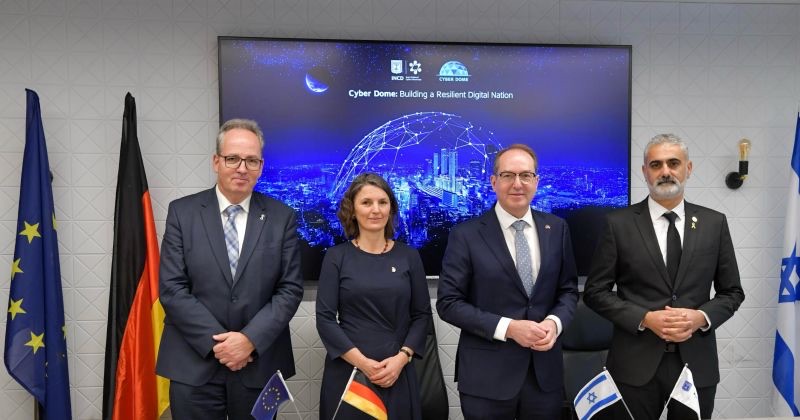
Cyber and security pact with Israel

June 2025 – January 2026

Alexander Dobrindt standing with three German and Israeli officials in front of a screen reading Cyber Dome: Building a Resilient Digital Nation, with EU, German and Israeli flags
With German and Israeli officials at a “Cyber Dome” presentation in Israel.
3Context
Rising cyber attacks and hybrid threats; Israel’s experience with an automated national cyber defence.
4Objective
Build a German “Cyber Dome” and deepen security cooperation.
5Action taken
Visit to Israel 28–29 June 2025; pact signed with Prime Minister Netanyahu in Jerusalem on 11 January 2026, covering cyber defence, a joint AI and cyber innovation centre, drone detection, civil protection and counter-terrorism.
6Stakeholders
BMI, BSI, Israel’s National Cyber Directorate, security agencies.
7Outcome
A political declaration of intent, not a treaty; first joint cyber-defence exercise in 2026.
8Public reaction
Presented by the ministry as an expression of Germany’s commitment to Israel’s security.
9Criticism
No substantial criticism specific to the pact is documented in the sources consulted; it sits within a wider public debate about German–Israeli relations.
10Long-term significance
Could shape the architecture of German cyber defence; implementation is ongoing.
09

Drone defence

October 2025 – 2026

3Context
Drone sightings closed Munich airport twice in early October 2025; suspected hybrid activity across Europe.
4Objective
Detect and neutralise drones over critical infrastructure.
5Action taken
Federal Police drone-defence unit and joint federal–state drone defence centre (December 2025); Aviation Security Act amended 26 February 2026 to allow Bundeswehr assistance, including shooting down drones.
6Stakeholders
Federal Police, Länder police, Bundeswehr, airports, operators of critical infrastructure.
7Outcome
New capabilities in place; an explosive drone found at Leipzig/Halle in August 2026 was attributed to Russia.
8Public reaction
Broad support for stronger defences; the law passed with CDU/CSU, SPD and AfD votes.
9Criticism
The Greens and the Left voted against the law; the domestic use of the armed forces is constitutionally sensitive in Germany.
10Long-term significance
Part of a broader shift of the interior ministry towards resilience against hybrid threats.