Record · Chapter 18

Controversies & criticism

A serious political biography must record the disputes as carefully as the achievements. The fourteen episodes below are documented in reputable sources; allegations are identified as such, and Dobrindt’s response is given where one is on record.

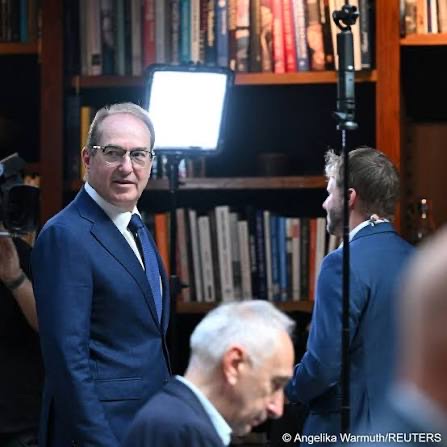
Alexander Dobrindt in a blue suit looking towards cameras and studio lights in a room lined with bookshelves
Under media scrutiny. Photo: Angelika Warmuth/Reuters (credit as shown in the image).
C-01

Euro-crisis remarks

What happened

As CSU Secretary General, Dobrindt said in February 2012 that Greece should seriously consider a new start outside the eurozone if it lacked the will to reform, and in August 2012 that he expected Greece to leave the euro in 2013. Later that year he was reported to have called ECB President Mario Draghi a “counterfeiter of Europe”.

Main criticism

Chancellor Merkel urged coalition politicians to weigh their words. The pro-European association Europa-Union Deutschland gave him its negative “Europa-Distel” prize in October 2012 for anti-European comments.

His position

He presented his remarks as insistence on reform conditions in exchange for financial aid. No retraction is documented.

Consequences: Greece remained in the eurozone. The episode cemented his image as a combative, eurosceptic voice of the CSU at the time.
C-02

ZDF phone call affair

What happened

CSU spokesman Hans Michael Strepp telephoned the newsroom of ZDF’s heute about its coverage of a Bavarian SPD party conference. After public criticism of attempted political influence on a public broadcaster, Strepp resigned on 25 October 2012.

Main criticism

Some media and opposition politicians questioned whether the call had been made with the knowledge of party headquarters, which Dobrindt led, and called for him to leave the ZDF television council. These were allegations; no evidence of his involvement was established.

His position

Dobrindt denied any knowledge of the call.

Consequences: Strepp’s resignation; Dobrindt remained a member of the ZDF television council until March 2014.
C-03

“Shrill minority”

What happened

In the debate on equal treatment of same-sex partnerships, Dobrindt described advocates as a “schrille Minderheit” (shrill minority) and said the Union should give a voice to the “silent majority”.

Main criticism

The remark was criticised by opposition parties and the FDP, and also within the Union, including by Horst Seehofer and CDU politicians such as Jens Spahn.

His position

No retraction is documented in the sources consulted.

Subsequent developments: The Bundestag opened marriage to same-sex couples in June 2017.
C-04

The car toll

What happened

Dobrindt designed and passed a car toll that compensated German drivers through vehicle tax relief. In April 2017 he complained of the “constant Austrian toll-grumbling” („Ösi-Maut-Maulerei“). Austria sued in October 2017.

Main criticism

Opponents argued from the outset that the design discriminated against EU citizens and that revenue forecasts were inflated. Austrian politicians objected to his tone.

His position

He argued that the toll closed a “fairness gap” and pointed to the European Commission’s approval of the amended law in May 2017.

Consequences: The EU Court of Justice struck the toll down on 18 June 2019. The subsequent dispute with operators, handled by his successor Andreas Scheuer, led to a Bundestag committee of inquiry and €243 million in compensation agreed in 2023.
C-05

Handling of the diesel scandal

What happened

After the Volkswagen manipulation was revealed, the Federal Motor Transport Authority ordered a recall of 2.4 million VW cars and a ministry commission led to “voluntary” recalls of around 630,000 vehicles from other makers. A 2017 diesel forum agreed software updates for 5.3 million cars.

Main criticism

Environmental and consumer organisations, including Deutsche Umwelthilfe and Greenpeace, accused the ministry of protecting the car industry, relying on voluntary measures and withholding test data. Deutsche Umwelthilfe went to court to obtain commission files.

His position

He defended the ministry’s handling of the affair as a witness before the Bundestag’s committee of inquiry on 16 February 2017.

Consequences: The debate on driving bans and hardware retrofits continued under his successors.
C-06

Projects in his home region

What happened

The draft Federal Transport Infrastructure Plan included around €540 million for three tunnel bypasses in the Garmisch-Partenkirchen and Oberau area of his constituency.

Main criticism

Bavarian SPD and Green politicians accused him of favouring his own region.

His position

No specific response from Dobrindt to this criticism is documented in the sources consulted.

Consequences: The projects remained part of the adopted plan.
C-07

“Conservative revolution”

What happened

In a guest essay for Die Welt, Dobrindt wrote that the “left-wing revolution of the elites” would be followed by a “conservative revolution of the citizens”.

Main criticism

Critics noted that “Conservative Revolution” is also the name of an anti-democratic intellectual movement of the Weimar Republic. Left Party leader Bernd Riexinger and SPD politician Karl Lauterbach accused him of adopting the language of the far right.

His position

He did not withdraw the term and described resistance to it as coming from left-wing mainstream elites.

Consequences: The essay became a reference point in debates about the CSU’s course before the 2018 Bavarian election, in which the party lost its absolute majority.
C-08

“Anti-deportation industry”

What happened

After an incident at a refugee shelter in Ellwangen, Dobrindt told Bild am Sonntag that an “aggressive anti-deportation industry” was deliberately sabotaging the rule of law.

Main criticism

Lawyers’ associations, including the German Bar Association, refugee councils and opposition parties objected that the term disparaged lawyers and volunteers exercising legal rights. On 15 January 2019 the term was chosen as Germany’s Unwort des Jahres 2018.

His position

No retraction is documented.

Consequences: The phrase remains one of the most cited examples in debates about political language on migration.
C-09

“Climate RAF”

What happened

Dobrindt warned against the emergence of a “Klima-RAF” in connection with the protest group Letzte Generation, alluding to the terrorist Red Army Faction.

Main criticism

The then president of the Federal Office for the Protection of the Constitution, Thomas Haldenwang, called the comparison “nonsense” from a professional perspective.

His position

No retraction is documented in the sources consulted.

Consequences: The term entered the wider debate about climate activism and criminal law.
C-10

Ukrainian refugees

What happened

He told Bild am Sonntag that Ukrainian refugees should take up work in Germany or return to safe areas of western Ukraine.

Main criticism

The Federal Foreign Office said there were no safe places in Ukraine; FDP politician Marie-Agnes Strack-Zimmermann called the proposal “bizarre”; Mecklenburg-Vorpommern’s Minister-President Manuela Schwesig also rejected it.

His position

He presented it as a principle that should apply “more than two years after the start of the war”.

Consequences: The Union continued to call for changes to benefits for Ukrainian refugees, which the 2025 coalition took up.
C-11

Migration votes with AfD support

What happened

After the Aschaffenburg knife attack, the Union under Friedrich Merz and Dobrindt brought a five-point migration motion to the vote. It passed on 29 January 2025 by 348 to 344 votes with support from the AfD and FDP. The Influx Limitation Act failed on 31 January (338 to 349).

Main criticism

The SPD, Greens, churches and hundreds of thousands of demonstrators accused the Union of breaching the firewall against the far right. Former Chancellor Merkel publicly criticised the decision.

His position

The Union argued that it would not make its proposals dependent on who else voted for them, and that it had offered the SPD and Greens the chance to support them.

Consequences: The Union won the election on 23 February 2025 and formed a coalition with the SPD, which ruled out any cooperation with the AfD.
C-12

Border rejections in court

What happened

The Berlin administrative court ruled on 2 June 2025 that the rejection of three Somali asylum seekers had been unlawful. On 27 April 2026 the Koblenz administrative court found a control at the Luxembourg border unlawful.

Main criticism

Opposition parties, legal scholars and neighbouring governments argued that the practice violated EU law. SPD parliamentary leader Matthias Miersch said blanket rejections would no longer be possible after the first ruling.

His position

„Wir halten an unserer Rechtsauffassung auch fest.“ He described both rulings as individual-case decisions and pursued main proceedings and appeals.

Subsequent developments: Controls were extended to March 2027. Stationary controls on the Luxembourg border were moved to mobile checks in May 2026, according to one report; he denied a link to the ruling.
C-13

Surveillance plans and Palantir

What happened

His security package included biometric internet searches and an openness to using Palantir data-analysis software for federal police authorities.

Main criticism

The civil-liberties organisation Digitalcourage gave him a BigBrotherAward on 13 October 2025. The SPD-led justice ministry rejected Palantir at federal level.

His position

He called for a “technology-neutral” assessment of analysis software.

Subsequent developments: As of 2026 the government stated that no procurement decision on Palantir had been made.
C-14

Dealings with the Taliban

What happened

To enable deportations of offenders to Afghanistan, his ministry held talks with the Taliban authorities and accepted Taliban consular staff in Germany; a first direct charter flight took place on 25 February 2026.

Main criticism

The Greens and human-rights organisations warned that the arrangements amounted to de facto recognition of the Taliban and raised concerns about conditions in Afghanistan.

His position

He said the arrangement created a reliable basis for direct and lasting deportations of offenders.

Subsequent developments: Chancellor Merz defended the arrangements in June 2026.