Career · Chapter 08

Political leadership

How does Alexander Dobrindt lead? This chapter sets the documented record beside the interpretations of observers — and marks which is which.

Key:EvidenceInterpretation
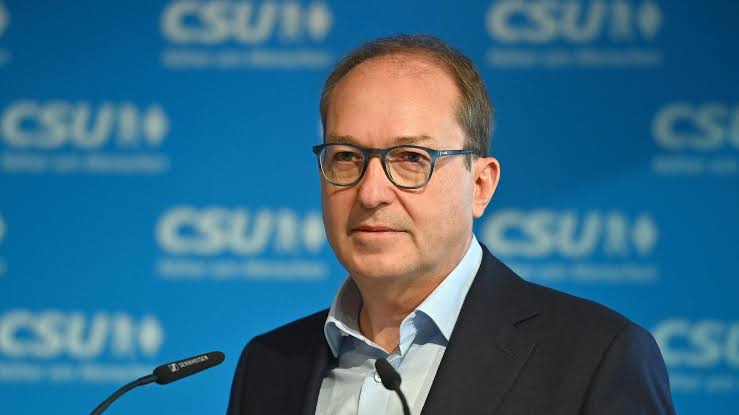
Alexander Dobrindt speaking at a microphone in front of a blue CSU backdrop
Giving a statement in front of the CSU backdrop.

At a glance

  • 8 years as chairman of the CSU Landesgruppe (2017–2025)
  • 4 years as CSU Secretary General (2009–2013)
  • 3 coalition rounds as a CSU negotiator: 2017 (Jamaica talks), 2018 and 2025
  • 2 ministries led, a decade apart

01Leadership style

Evidence

Dobrindt has repeatedly used deliberately pointed formulations — the “anti-deportation industry” (2018), the “conservative revolution of the citizens” (2018), the warning against a “climate RAF” (2022). He has rarely retracted such statements. As minister he has framed his agenda in short triads, such as “clarity, consistency and control” on taking office.

Interpretation

Observers describe a two-sided style: a confrontational public voice and a disciplined, discreet negotiator in private. Supporters see this as effective agenda-setting; critics see a calculated escalation of rhetoric that legitimises harder positions.

02Political priorities

Evidence

Across two decades the constants are infrastructure and the user-pays principle (2013–2017), and since 2015 above all migration and internal security. As interior minister his first act was to tighten border controls; most of the laws he has introduced concern asylum, citizenship and police powers.

Interpretation

His priorities track the CSU’s strategic needs: in 2013 a populist-conservative project for Bavarian voters (the car toll), after 2015 the issue on which the CSU felt most exposed to competition from the right.

03Negotiation & coalition politics

Evidence

He was part of the CSU’s negotiating teams in the 2017 Jamaica exploratory talks (which the FDP left on 19 November 2017), in the 2018 grand coalition negotiations and, alongside Markus Söder, in the 2025 talks with the SPD. The 2025 coalition agreement adopted rejections at the border “in coordination with” neighbouring countries — a formulation that left room for interpretation.

Interpretation

The Landesgruppe chairman holds a structural veto position in Union-led coalitions. Dobrindt is widely regarded as having used it to secure CSU priorities on migration in 2025 — and later, as minister, to interpret the agreed language expansively.

04Public communication

Evidence

He is a frequent guest on political talk shows and gives interviews mainly to large-circulation outlets such as Bild am Sonntag, where several of his best-known statements first appeared. The term “Anti-Abschiebe-Industrie” was chosen as Germany’s Unwort des Jahres 2018.

Interpretation

The choice of outlet and wording is consistent with a strategy of addressing voters directly rather than through the specialist press. It has made him one of the most recognisable CSU politicians outside Bavaria, and one of the most polarising.

05Party leadership

Evidence

He has never chaired the CSU or held office in the Bavarian government. On 1 July 2018 he publicly refused to accept party chairman Horst Seehofer’s resignation offer. In July 2026, after Jens Spahn resigned as leader of the Union parliamentary group, Dobrindt was mentioned as a possible successor; the group elected Thorsten Frei on 29 July 2026, and Dobrindt remained interior minister.

Interpretation

His influence derives from proximity to the party leader and control of the Berlin apparatus rather than from a mass base in the party — a profile closer to a chief of staff than a tribune.

06Parliamentary influence

Evidence

As first deputy chairman of the CDU/CSU group from 2017 to 2025 he served under three group chairmen — Volker Kauder, Ralph Brinkhaus and Friedrich Merz. In January 2025 he was among the Union leaders who brought a migration motion to the vote that passed with AfD support.

Interpretation

His longevity across three chairmen and two governments is itself evidence of influence. The January 2025 votes showed both his willingness to take political risks and the limits of that approach: the bill failed, and the episode remains contested.

07Strategic positioning

Evidence

In May 2025 he said he did not believe the AfD could simply be banned out of existence; it had to be “governed away”. As minister he presented domestic intelligence reports showing a sharp rise in right-wing extremist potential (up 17 per cent to 58,700 people in the 2025 report), and in 2026 his ministry ordered an in-depth review after a court provisionally barred the domestic intelligence service from labelling the AfD as confirmed right-wing extremist.

Interpretation

His strategy rests on the premise that a centre-right government can reduce support for the far right by delivering visible results on migration. Whether that premise holds is one of the central open questions of his time in office.

„Ich glaube nicht, dass man eine AfD einfach wegverbieten kann, sondern man muss sie wegregieren.“ “I don’t believe you can simply ban the AfD out of existence; you have to govern it away.” Alexander Dobrindt, ZDF “Berlin direkt”, May 2025 (as reported by ZDFheute)