Government · Chapter 11
Digital infrastructure
When the transport ministry was renamed in December 2013, it gained responsibility for telecommunications and broadband. For four years Dobrindt was Germany’s minister for networks of every kind — fibre and mobile spectrum as well as motorways — and laid down the first legal framework for automated cars.
- Remit gained
- Telecoms & broadband, 17 Dec 2013
- Target
- ≥ 50 Mbit/s for all households by 2018
- Funding programme
- €2.7bn in 2015, later ≈ €4bn
- Spectrum auction
- €5.08bn, June 2015
- Automated driving law
- In force 21 June 2017
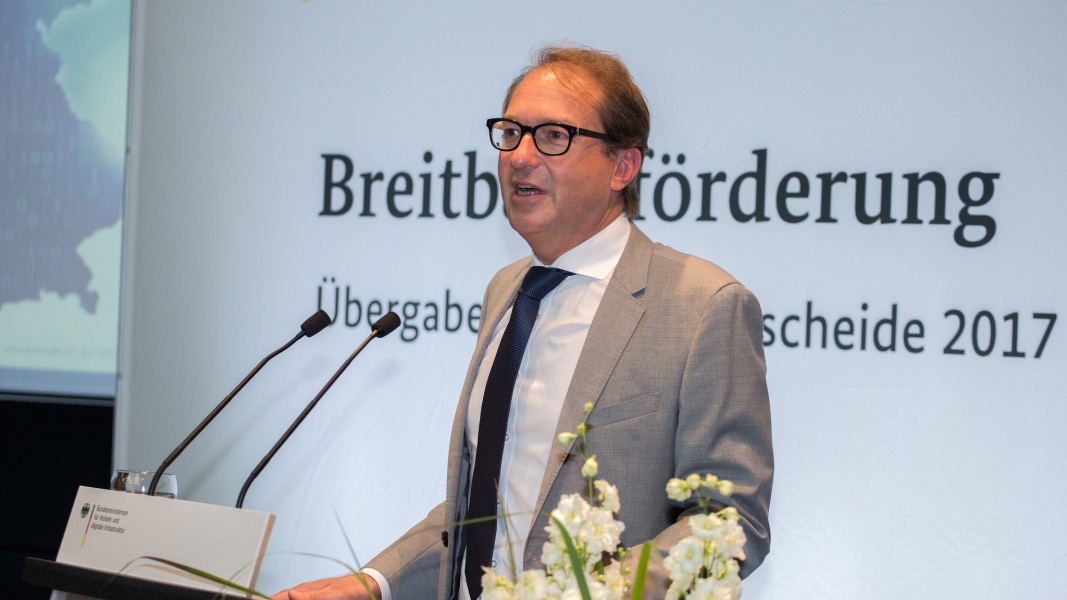
Fifty megabits for everyone
Fact
On 7 March 2014 Dobrindt launched the Netzallianz Digitales Deutschland, an alliance of the ministry with network operators and industry associations. Its stated goal was nationwide availability of at least 50 Mbit/s by 2018 — the target already set out in the 2013 coalition agreement and the federal government’s Digital Agenda. Member companies pledged investment of around €8 billion a year.
To close gaps where private investment was unprofitable, mainly in rural areas, the federal cabinet approved a broadband funding programme in October 2015. Launched on 18 November 2015 with €2.7 billion — about €1.3 billion of it from spectrum auction proceeds and €1.4 billion from the federal budget — it was later increased to around €4 billion. Municipalities and districts applied for grants; Dobrindt personally handed over many of the funding decisions at public events from early 2016.
Fact
The 2015 auction of mobile spectrum, which closed on 19 June 2015 after several weeks, raised €5.08 billion from Deutsche Telekom, Vodafone and Telefónica for 270 MHz of spectrum. Proceeds from the 700 MHz band (“Digital Dividend II”), about €1.33 billion, were shared between the federal government and the Länder and earmarked for broadband expansion.
Result & criticism
The 50 Mbit/s target was not met. According to the federal broadband atlas, around 88 per cent of households had access to at least 50 Mbit/s at the end of 2018. Critics — including opposition parties and parts of the industry — argued that a bandwidth target of 50 Mbit/s encouraged upgrading existing copper lines rather than building fibre to the home, and that complex funding procedures slowed down projects. Later governments shifted the goal towards gigabit and fibre networks.
A legal framework for cars that drive themselves
- 4 Sep 2015
Digital test field A9
An innovation charter turns the A9 motorway between Munich and Nuremberg into a test track for automated and connected vehicles, with federal funding for sensor infrastructure.
- 16 Sep 2015
National strategy
The cabinet adopts the “Strategy for Automated and Connected Driving”, presented at the Frankfurt motor show.
- 17 Sep 2015
G7 declaration
Under Germany’s G7 presidency, transport ministers meeting in Frankfurt adopt a declaration on automated and connected driving.
- Sep 2016
Ethics commission
Dobrindt appoints an ethics commission chaired by former constitutional judge Udo Di Fabio.
- 30 Mar 2017
Road traffic act amended
The Bundestag passes the amendment allowing highly automated driving functions; the Bundesrat follows on 12 May 2017.
- 20 Jun 2017
Twenty ethical rules
The commission presents its report: protecting human life takes priority over property damage, and any weighing of victims by personal characteristics is prohibited.
- 21 Jun 2017
Law in force
Drivers may turn their attention away from traffic while an automated system drives but must remain ready to take over; a data recorder documents who was in control.
Political position
Dobrindt presented automated driving as a question of industrial leadership for Germany’s car industry and of road safety. After the Bundesrat vote in May 2017 he described the amendment, according to trade press reports, as the most modern road traffic law in the world.
Analysis
The ethics guidelines were among the first of their kind internationally and are still widely cited in academic and regulatory debates. Critics noted that the 2017 law left open questions on liability and data protection; a further law on autonomous driving (Level 4) followed in 2021 under his successor’s ministry.
What was — and was not — his ministry’s work
Fact
The abolition of liability for operators of open Wi-Fi hotspots (Störerhaftung) in 2016–2017 is sometimes attributed to Dobrindt. The lead ministry for those amendments to the Telemedia Act was the Federal Ministry for Economic Affairs, not the transport ministry.
Fact
The broadband programmes he launched were continued by his successor Andreas Scheuer and, from December 2021, by the Federal Ministry for Digital and Transport under Volker Wissing, which redesigned federal funding around gigabit and fibre networks.
From networks to network security
Fact
As Federal Minister of the Interior since May 2025, Dobrindt is responsible for the Federal Office for Information Security (BSI) and for national cyber security legislation. The Bundestag passed the law implementing the EU’s NIS2 directive on 13 November 2025, extending cyber security obligations to around 29,500 companies.
On 11 January 2026 in Jerusalem he and Israeli Prime Minister Benjamin Netanyahu signed a German–Israeli cyber and security pact — a political declaration of intent rather than a treaty — covering cooperation on a German “Cyber Dome”, a partially automated system for detecting and responding to cyber attacks, as well as drone defence and civil protection. The first joint German–Israeli cyber-defence exercise followed in 2026.
„Wir haben ein großes Interesse daran zu lernen, wie Israel den Cyber-Dome aufgebaut hat.“ “We have a strong interest in learning how Israel built its Cyber Dome.” Alexander Dobrindt, Jerusalem, January 2026 (Federal Ministry of the Interior)